
New Haven Criminal Records Search
New Haven County holds criminal records across three judicial districts. The county seat is New Haven, where the main Superior Court sits. Residents can search for court cases, arrest records, and conviction history through multiple channels. Local police departments maintain incident reports and booking records. State agencies also provide access to rap sheets and inmate data. This guide explains how to find criminal records in New Haven County. The New Haven criminal records system provides multiple access points for residents.
New Haven County Court Records Access
New Haven County operates three judicial districts with separate Superior Courts. Each court handles criminal cases from towns in its area. The New Haven Judicial District serves the central county towns. The Ansonia-Milford Judicial District covers the southwestern area. The Waterbury Judicial District handles cases from the northern part of the county. All courts follow Connecticut's unified court system rules and procedures. The New Haven Superior Court sits at 121 Elm Street in New Haven. This New Haven location handles felony cases and serious misdemeanors from the central district. You can reach the New Haven clerk's office by phone at (203) 503-6800. The New Haven courthouse opens Monday through Friday from 8:30 AM to 4:00 PM. Public computers allow free case lookups in the lobby.
Records at the New Haven courthouse include arrest warrants, charging documents, and disposition records. Court clerks maintain files for all cases filed in the district. You can request copies of documents in person during business hours. The court also provides certified copies for official purposes. Fees vary based on the number of pages requested. Towns served by the New Haven Judicial District include New Haven, East Haven, West Haven, Hamden, and North Haven. Wallingford, Meriden, Cheshire, Branford, and North Branford also fall under this court. Guilford, Madison, Bethany, and Woodbridge complete the list. Cases from these towns are filed at the New Haven location. Staff at the New Haven court can help you navigate the records system. The New Haven courthouse serves as the primary location for central county criminal matters. Contact the New Haven clerk's office for assistance with case files.
Ansonia and Milford Court Locations
The Ansonia-Milford Judicial District splits caseload between two courthouses. The Ansonia Superior Court is located at 2 Main Street in Ansonia. Their phone number is (203) 736-8400. This court serves Derby, Ansonia, Seymour, and Oxford. Smaller towns like Beacon Falls and Naugatuck also report here. Criminal cases from these communities start at the Ansonia location.
Milford Superior Court operates at 14 West River Street in Milford. Call (203) 877-5311 for clerk assistance. This courthouse handles cases from Milford, Orange, and West Haven. Some matters from the southern district also appear here. The Milford location offers the same services as the Ansonia court. You can search cases from either location through the Judicial Branch website. The online portal covers all criminal and motor vehicle matters. Search by name or case number to find docket information. The system displays charges, court dates, and case status. Updates occur daily as clerks process new filings. The Ansonia and Milford courts serve as important alternatives to the New Haven courthouse for southern county residents. Many New Haven area residents find these locations more convenient than traveling to downtown New Haven.
Waterbury Judicial District Records
The Waterbury Superior Court serves the northern portion of New Haven County. This courthouse is located at 300 Grand Street in Waterbury. The clerk's office phone is (203) 596-4000. Hours follow the standard 8:30 AM to 4:00 PM schedule. The Waterbury district also serves parts of Litchfield County. Criminal cases from several towns are consolidated here.
Access to Waterbury court records follows the same process as other districts. Visit the clerk's office for in-person requests. Use the online case lookup for remote searches. The court maintains files for all pending and closed cases. Disposition information is available once cases conclude. CGS § 1-210 guarantees public access to most court records in Connecticut. This statute applies to all Superior Courts in New Haven County. Some records may be sealed by judicial order. Victim information and juvenile cases receive special protections. Most adult criminal cases remain open to public inspection. The Waterbury court works alongside the New Haven and Ansonia-Milford districts to serve county residents. Together these three districts ensure comprehensive coverage for all New Haven County criminal cases. The New Haven Superior Court remains the busiest location in the county.
New Haven Police Records and Reports
Local police departments maintain arrest records and incident reports. The New Haven Police Department is located at 1 Union Avenue. Their records division can be reached at (203) 946-6312. Police reports document arrests, accidents, and investigated incidents. These records serve as the foundation for court cases. They also help track crime trends in each community. Under CGS § 1-215, arrest records are public from the moment of arrest. These records include the suspect's name and address. The date, time, and location of arrest are also public. The specific charges filed appear in the record. Police may withhold witness names in sensitive investigations.
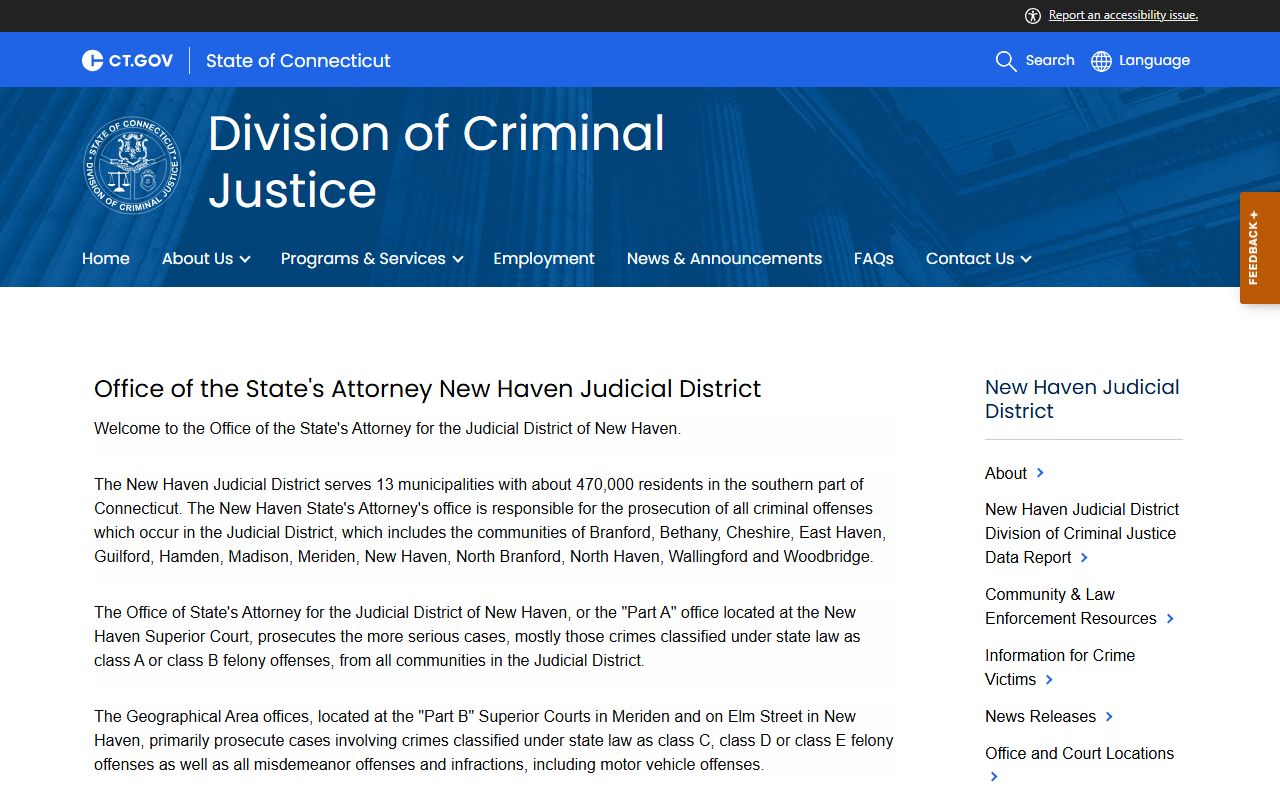
The New Haven Judicial District State's Attorney prosecutes criminal cases. Their office reviews arrests and files formal charges. They do not provide public access to case files. All record requests go through the courts or police. The State's Attorney works from offices at the New Haven courthouse. Each town in New Haven County has its own police department or regional coverage. Larger cities like New Haven and Meriden have dedicated departments. Smaller towns may contract with state police or share services. All follow the same public records laws. Request procedures vary slightly by department. The New Haven Police Department maintains the largest municipal police records system in the county. New Haven officers generate thousands of reports annually.
State Criminal Records for New Haven County
State agencies maintain records that cover New Haven County arrests and convictions. The State Police Bureau of Identification provides official rap sheets. These records include all arrests statewide, not just New Haven. The Bureau is located at 1111 Country Club Road in Middletown. Request forms are available online through the DESPP portal. Visit the State Police Bureau of Identification website for record request forms. The site provides instructions for name-based and fingerprint searches. Fees apply for both types of requests. Results arrive by mail within two to four weeks. The Bureau does not offer expedited services.
The Department of Correction Inmate Search tracks current prisoners. This database includes pretrial detainees from New Haven County jails. You can search by name or inmate number. Results show custody status, facility location, and projected release dates. The system covers all inmates held in state facilities. CGS § 54-142a governs the erasure of criminal records in Connecticut. Cases dismissed or nolled become eligible for erasure. The time frame depends on the disposition type. Erased records may not appear in standard searches. The Clean Slate law also affects many New Haven County records. Eligible convictions erase automatically after seven or ten years. The State Police Bureau maintains comprehensive criminal records for all New Haven arrests. Every New Haven arrest appears in this statewide database.
How to Request New Haven County Records
Obtaining criminal records in New Haven County requires following specific steps. First, identify which agency holds the records you need. Court records stay with the Judicial Branch. Police reports remain with local departments. State-level rap sheets come from the State Police Bureau. Each agency has its own request process. For court records, visit the appropriate Superior Court clerk's office. Bring the case number if you have it. Staff can help locate files using names and dates. Request copies of specific documents or entire case files. Fees depend on the number of pages copied. Certified copies cost extra for official use.
Police records require direct contact with each department. Some offer online request portals. Others require written requests by mail or in person. Include as much detail as possible about the incident. Dates, locations, and names help locate reports. Response times vary by department workload. The Connecticut Freedom of Information Commission can help with denied requests. They enforce CGS § 1-210 and related statutes. File a complaint within 30 days of any denial. The Commission reviews each case and issues binding decisions. Their office is at 165 Capitol Avenue in Hartford. Understanding the request process helps you obtain New Haven criminal records more efficiently. Following the correct procedures ensures faster processing of your New Haven records request.
Online Resources for New Haven Records
Several websites provide access to New Haven County criminal information. The Judicial Branch case lookup portal offers free searches. Visit the criminal case information page to start your search. You can look up cases by name or docket number. The system shows charges, court dates, and dispositions. The New Haven Police Department provides online resources for report requests. Visit the NHPD reports request page for instructions. Some reports may be available electronically. Others require in-person pickup at police headquarters. Accident reports follow different procedures than incident reports.
Third-party services also aggregate public record data. These sites search multiple databases at once. Results may include court records, arrest logs, and news articles. Always verify information through official sources. Government agencies provide the most accurate and current data. Remember that online databases have limitations. Recent cases may not appear immediately. Sealed records remain hidden from public view. Some agencies update systems only weekly or monthly. For the most current information, contact the agency directly. The online resources for New Haven criminal records continue to expand each year. New Haven residents benefit from improved digital access to court records and police reports.
New Haven County Criminal Records Facts
New Haven County is the third most populous county in Connecticut with approximately 860,000 residents. The county spans 606 square miles along Long Island Sound. The New Haven Judicial District processes thousands of criminal cases each year. Case volume includes felonies, misdemeanors, and motor vehicle violations. The three-district system helps manage the high volume of court records in New Haven County. Superior Courts in New Haven County handle diverse case types. Criminal dockets include violent crimes, property offenses, and drug charges. Motor vehicle cases cover DUIs, reckless driving, and license violations. Family violence matters receive specialized handling in dedicated court sessions. Each case generates records available to the public under state law. Records retention follows Connecticut state guidelines. Court files remain archived for decades after cases close. Digital systems now store newer case information. Older records may exist only in paper format at storage facilities. The Judicial Branch is working to digitize historical New Haven County case files.
New Haven Criminal Records Access Guide
Finding criminal records in New Haven requires knowing which office holds the files. The New Haven Superior Court keeps court documents for cases filed there. Arrest records stay with the police department that made the arrest. State-level criminal history comes from the State Police Bureau. Each source offers different types of records for different purposes. The main New Haven courthouse handles serious criminal matters from central county towns. Defendants appear here for arraignments, pre-trial hearings, and trials. Clerks file all documents related to each case. Public terminals let visitors search the case management system. Paper files are available for older cases not yet digitized.
Police records from New Haven include incident reports and arrest logs. The records division processes requests from the public and attorneys. Some information may be redacted for privacy or safety reasons. Response times depend on the age and complexity of the request. Older cases may require manual retrieval from archives. CGS § 1-210 and CGS § 1-215 form the legal basis for records access in New Haven. These laws guarantee the public can view most government documents. Exceptions exist for ongoing investigations and sealed cases. The Freedom of Information Commission resolves disputes about access. Their rulings apply to all agencies holding New Haven criminal records.
Criminal Records by New Haven Town
Each town in New Haven County reports criminal cases to specific courts. New Haven city residents file cases at the New Haven Superior Court. East Haven and West Haven also report to this downtown courthouse. North Haven and Hamden cases appear at the same location. Wallingford and Meriden residents use the New Haven court for criminal matters. Cheshire and Bethany send cases to New Haven as well. Branford and North Branford are also part of this judicial district. Guilford and Madison complete the list of towns served. Woodbridge residents appear at the New Haven courthouse for all criminal proceedings. Each town maintains local police departments for initial arrests.
Milford and Orange residents report to the Milford Superior Court. West Haven cases may appear at either New Haven or Milford depending on the arrest location. Derby, Ansonia, and Seymour use the Ansonia courthouse. Oxford and Beacon Falls also file cases in Ansonia. Naugatuck reports to Ansonia despite being in New Haven County. Waterbury serves several northern New Haven County towns. Prospect and Naugatuck may have cases in Waterbury as well. The judicial district boundaries do not always follow county lines. Always verify which court handles your specific case. The Judicial Branch website lists all towns and their assigned courts. Knowing your town's assigned court helps you locate New Haven County criminal records quickly. Check with New Haven court officials if you are unsure which location handles your case.
Types of Criminal Records in New Haven
New Haven County maintains various types of criminal records. Arrest records document when police take someone into custody. Incident reports describe the circumstances of alleged crimes. Court records track cases from filing through final disposition. Conviction records show guilty findings and sentences imposed. Each type serves different purposes for researchers and requesters. Rap sheets provide comprehensive criminal history from the State Police. These records include all arrests, charges, and outcomes. They show dismissed cases alongside convictions. The Bureau of Identification maintains official rap sheets. Fingerprint-based searches provide the most accurate results for New Haven criminal history checks.
Docket information shows case status and upcoming court dates. Disposition records indicate how cases were resolved. Some charges result in convictions while others are dismissed. Nolle prosequi means the prosecutor declined to pursue the case. Each outcome creates a different type of record. Inmate records track people held in correctional facilities. The Department of Correction maintains custody records. These files show sentence length and release dates. Pretrial detainees from New Haven appear alongside convicted prisoners. The online inmate search provides current custody information. Understanding the different types of New Haven criminal records helps you request the correct documents. The New Haven courts and police can guide you to the appropriate records for your needs.
New Haven Criminal Records History
The New Haven court system has evolved over centuries. The current Superior Court system was established in 1974. Before that, various courts handled criminal matters in New Haven County. Court records from earlier periods may be archived at the Connecticut State Library. Historical criminal records provide insight into past legal practices in New Haven. New Haven has long served as a judicial center for the region. The courthouse on Elm Street replaced older facilities in the twentieth century. Modern record-keeping began with computerized systems in the 1980s. Today, New Haven court records are primarily digital. Paper records from before 2000 may require special requests.
The New Haven Police Department has maintained arrest records since the department's founding. Early records were handwritten in log books. Modern police records include digital reports and electronic databases. The transition to computerized systems improved search capabilities. Historical arrest records may still exist in paper archives. State-level criminal record-keeping also changed over time. The State Police Bureau of Identification was created to centralize records. Fingerprint-based identification became standard in the twentieth century. Today, the Bureau maintains digital rap sheets for all Connecticut arrests. New Haven County arrests appear in this statewide database. The evolution of New Haven criminal records reflects broader changes in technology and public access laws. Today's New Haven records system balances transparency with privacy protections.
Sealed and Erased New Haven Records
Not all criminal records in New Haven are available to the public. Some records are sealed by court order. Others are automatically erased under state law. Sealed records exist but are hidden from public view. Erased records are treated as if they never existed. CGS § 54-142a provides for automatic erasure of certain criminal records in New Haven. Dismissed cases erase after twenty days. Nolled cases erase after thirteen months. Records of acquittals erase immediately upon verdict. These erased records should not appear in background searches. The Clean Slate law expands automatic erasure to certain convictions. Misdemeanors erase after seven years from the most recent conviction. Class D and E felonies erase after ten years. The clock starts from the date of conviction or release from incarceration.
Not all convictions qualify for Clean Slate erasure. Some New Haven criminal records are sealed by court order. Family violence cases may have sealed components. Juvenile records are generally confidential. Certain victim information is protected from disclosure. Sealed records remain accessible to law enforcement and courts. The general public cannot view sealed case files. Record erasure affects how people answer questions about their history. Once erased, a person may legally deny the arrest occurred. Employers cannot ask about erased records on applications. Housing providers also cannot consider erased criminal history. Understanding erasure helps people move forward after past mistakes. The sealed and erased New Haven criminal records system balances public access with individual privacy rights. New Haven courts carefully review requests to unseal records when appropriate.
New Haven County Record Locations
The New Haven Superior Court stands as the primary location for accessing court records in central New Haven County. Visitors to the New Haven courthouse can use public terminals to search for cases. The New Haven court clerk's office provides assistance with locating files and documents. Many people visit the New Haven location to obtain certified copies of court records. The New Haven Judicial District serves the largest population of any district in the county. For those researching New Haven area arrests, the New Haven Police Department records division offers access to incident reports. The New Haven police records staff can help locate specific reports by date or location. New Haven residents can request copies of reports involving themselves or their property.
The New Haven police also provide accident reports through a separate process. Contacting the New Haven records division directly ensures you receive the correct documents. New Haven County's three judicial districts work together to serve residents. While New Haven handles central county matters, the other districts serve their respective areas. New Haven remains the county seat and hosts the largest court operation. Records from all three districts are accessible through the unified state court system. Understanding which New Haven area court handles specific cases saves time when requesting documents.
New Haven Criminal Records Overview
The New Haven criminal records system serves residents throughout the county. New Haven courts maintain files on thousands of cases each year. These New Haven records include both misdemeanor and felony charges. Anyone seeking New Haven court documents can visit the appropriate courthouse. The New Haven Superior Court provides public access terminals for case searches. New Haven court staff are available to assist with locating specific records. Many New Haven cases begin with arrests by local police departments.
New Haven police records document incidents throughout the city. The New Haven Police Department generates reports for each arrest. These New Haven arrest records become part of the official case file. New Haven residents can request copies of police reports involving them. The New Haven records division processes these requests during business hours. Some New Haven police records may be exempt from public disclosure. New Haven law enforcement follows state guidelines for records retention.
Criminal records in New Haven County are maintained by multiple agencies. The New Haven courts keep case files and disposition records. New Haven police departments store arrest reports and incident logs. State agencies maintain rap sheets covering New Haven arrests. Each type of New Haven record serves a different purpose. Together these New Haven criminal records create a comprehensive picture of justice system activity. Understanding the New Haven records system helps people find the documents they need.